- 28/05/2024
- Category: Commentaries

Author: Hilman Nurjaman
Editor: Achmed Faiz Yudha Siregar
The development of digital technology has become a critical momentum in the transformation of various aspects of community life in recent times. The use of digital technology extends beyond just browsing information, interacting with others, or managing financial transactions. It has also brought changes in how individuals access and process information, starting from a very young age.1 In an era dominated by digital technology, society faces the demands to process comprehensive literacy skills, both physically and digitally, to meet daily needs. This has received strong support from the international agenda, especially since the UN launched the “Decade of Literacy” in 2015, targeting the eradication of global illiteracy.2 Initially, literacy was understood as the basic skills needed to process and comprehend information in reading and writing activities. However, with technological advancements, literacy has expanded to include skills for navigating, evaluating, and effectively and wisely using information, broadening in digital scope.3 Digital literacy skills are crucial in preparing the next generation to actively and responsibly engage in the digital society.
In efforts to measure literacy skills globally the Programme for International Student Assessment (PISA), operated by the Organisation for Economic Co-operation and Development (OECD), plays a key role. PISA conducts routine assessments every three years to evaluate the literacy skills of 15-year-old students in mathematics, reading, and science.4 The main focus of these assessments is to determine how proficient students are in solving problems, thinking critically, and communicating effectively. For instance, PISA 2022 involved about 690.000 students from 81 countries, providing insights into education and socio-economic background within states associated with student literacy achievements.5
The most recent PISA results for Indonesia show a decline

Source: https://oecdch.art/a40de1dbaf/C108
The PISA 2022 results published in December 2023 indicate that Indonesia ranks low with scores of 359 for reading, 366 for mathematics, and 383 for science, compared to the OECD’s average scores of 476 for reading and science and 472 for mathematics. Compared to the 2018 results, these scores show a decline, marking the lowest scores recorded since Indonesia’s participation in the PISA assessments. Over the 2018 to 2022 period, the gap between the top 10 percent of students and the bottom 10 percent illustrates a decrease in mathematics, while there were no significant changes in reading and science.6 Furthermore, very few Indonesian students reached level 5 or higher in reading skills, which involves understanding lengthy texts, abstract concepts, and the ability to distinguish between facts and opinions with content or information sources, compared to the OECD average of 7 percent.7 These findings highlight the major challenges confronting Indonesia’s education system, indicating a pressing need for more concerted efforts to improve its quality. Additionally, the significant disparities among students globally underscore the importance of adopting a more inclusive and equitable approach to providing educational resources, especially for those from socio-economically disadvantaged backgrounds.
The technology access gap poses a significant challenge in literacy education in the digital era
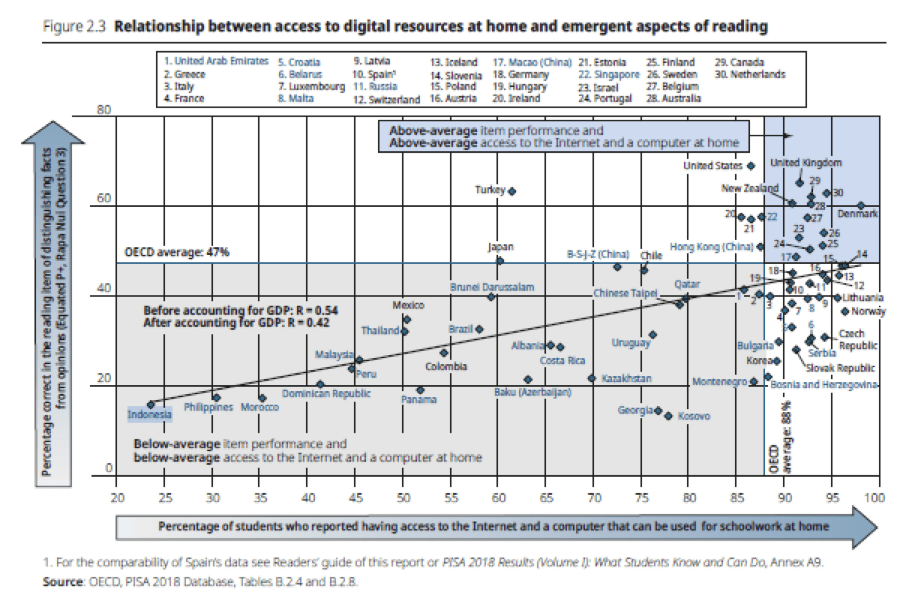
Similarly, the figure from PISA 2018 above highlights the significant disparities in access to technology, where on average, 89 percent of students in OECD countries have access to computers with internet connections. In contrast, less than half of students in Indonesia, Morocco, and the Philippines have access to a computer that they can use to do schoolwork at home.8 This situation reflects one of many challenges faced by countries with limited resources in providing adequate educational support. Students in countries with limited access to technology tend to have fewer learning opportunities, such as access to digital resources, online courses, or interactive learning materials available to them in countries with higher technological infrastructure. It’s no wonder that students unfamiliar with the use of digital technologies often struggle to respond to the changing times by developing digital skills to meet their needs. Therefore, it’s important to reduce the educational gap and ensure that all students have equal opportunities to attain high levels of achievement.

PISA also reports how students from various countries perform in skills necessary to distinguish facts from opinions and assess the credibility of sources, which are crucial components of literacy. In some countries like Australia, the United Kingdom, and the United States, over 60 percent of students show higher performance in aspects of separating facts and opinions and evaluating the credibility of information sources. However, in Indonesia, Morocco, and the Philippines, less than 20 percent of students demonstrate these abilities. The ability to differentiate between facts and opinions, as well as to assess the credibility of sources, is crucial for students to effectively manage information in a valid manner and safeguard themselves from misinformation. This underscores the importance of effective teaching in evaluating the credibility of information sources as part of digital literacy.9 Changes in how students access and consume information also reflect a shift from traditional media to digital media. Nowadays, students tend to read more in digital formats such as chats, online news, and practical information searches, and they are less likely to read physical books, magazines, or newspapers.10 In the current age of abundant and diverse information, the skill of identifying valid and reliable sources is becoming increasingly crucial to fostering smart and responsible users.
The need for education reform that responds to the digital era
The low scores for Indonesia in the PISA 2022 results highlight a number of structural issues within the educational system, particularly related to infrastructure and digital facilities. During the COVID-19 pandemic, for example, when remote learning became the new mode of education, students in OECD countries reported that they rarely encountered problems with distance learning and did not face issues with internet access and digital devices.11 In contrast, in Indonesia, the lack of adequate infrastructure in schools significantly contributed to barriers to learning and affected the overall quality of education.12 Additionally, other research has revealed that many schools in Indonesia face challenges with basic infrastructure, such as the availability of clean water and sanitation, computer facilities, and a stable electricity supply.1314 These deficiencies not only hinder the use of technology in education but also limit broader learning opportunities.
In this context, the low PISA scores not only reflect a gap in academic abilities but also highlight the need for reforms that are responsive to the challenges of the digital age within the education system. Necessary reforms include equalizing educational infrastructure to ensure equitable access to learning resources and updating curricula that emphasize the development of critical skills and adaptation to rapidly evolving information technology, both of which are essential competencies in the digital era. The success of these reforms will greatly depend on how well national curricula align with assessment standards used in PISA.15 These standards measure not only fundamental knowledge but also students’ abilities to apply this knowledge in real and complex situations that are more relevant to global demands.
PISA serves not only as an evaluation tool, but its results are also an important resource for policymakers to consider when formulating strategies to improve and enhance the quality of education. By utilizing the data and analysis provided by PISA, stakeholders can map out reform steps aimed at preparing students not only to succeed within the educational system but also to face future challenges, with the rapid advancement of technology, such as the emergence of artificial intelligence, the need for adaptation becomes even more pressing. Understanding the implications of PISA results, it is hoped that Indonesia can seize the opportunity to implement strategic changes that will not only enhance performance in global evaluations but also, more importantly, improve the quality and relevance of education for all students.
Conclusion
PISA represents a global initiative that emphasizes the measurement and comparison of student capabilities across different countries. It aims to provide a broad and deep perspective on the strengths and weaknesses of the educational systems of participating countries, helping to identify areas for improvement and innovation in education. The latest PISA results show that Indonesia still faces significant challenges in its efforts to enhance the quality of its education. The low scores in mathematics, reading, and science are invaluable inputs for evaluating and improving the quality of Indonesia’s education. This includes enhancing educational infrastructure and facilities, reforming curricula from elementary, and high school, to university, optimizing assessment systems, and ensuring equitable education quality across regions, contextualized with current developments in digital technology.
- Danby, S. J., Fleer, M., Davidson, C., & Hatzigianni, M. (Eds.). (2018). Digital Childhoods. Technologies and Children’s Everyday Lives. Singapore: Springer. ↩︎
- Janjic, Watrich and Vera. (2009) The Cambridge Handbook of Literacy by Olson, D.R. and Torrance, R. (Eds), Journal of Educational Research, 55, 4. ↩︎
- Sparks, J., Katz, I. and Beile, P. (2016). Assessing digital information literacy in higher education: a review of existing frameworks and assessments with recommendations for next-generation assessment, ETS Research Report Series. ↩︎
- OECD. (2023). PISA Results: Factsheets – Indonesia. ↩︎
- Donne, N. (2014). European Variations in Socioeconomic Inequalities in Students’ Cognitive Achievement: The Role of Educational Policies. European Sociological Review, 30, 329-343. https://doi.org/10.1093/esr/jcu040 ↩︎
- OECD. (2023). PISA Results: Factsheets – Indonesia. ↩︎
- Ibid. ↩︎
- OECD. (2023). PISA 2022 Results (Volume II): Learning During – and From – Disruption, PISA, OECD Publishing, Paris, https://doi.org/10.1787/a97db61c-en. ↩︎
- Ibid. ↩︎
- OECD. (2021). 21st-Century Readers: Developing Literacy Skills in a Digital World, PISA, OECD Publishing, Paris, https://doi.org/10.1787/a83d84cb-en. ↩︎
- OECD. (2023). PISA 2022 Results (Volume II): Learning During – and From – Disruption, PISA, OECD Publishing, Paris, https://doi.org/10.1787/a97db61c-en. ↩︎
- BPS. (2020). Potret Pendidikan Indonesia. ↩︎
- Mardita, N. (2019). Pengelolaan Sarana Dan Prasarana Pendidikan Untuk Meningkatkan Kualitas
Pembelajaran. https://doi.org/10.31227/osf.io/pa4r5 ↩︎ - Karon, A. J., Cronin, A. A., Cronk, R., & Hendrawan, R. (2017). Improving water, sanitation, and hygiene in schools in Indonesia: A cross-sectional assessment on sustaining infrastructural and behavioral interventions. International Journal of Hygiene and Environmental Health, 220(3), 539–550. https://doi.org/10.1016/J.IJHEH.2017.02.001 ↩︎
- Wu, L.Y. (2010) Applicability of the Resource-Based and Dynamic-Capability Views under Environmental Volatility. Journal of Business Research, 63, 27-31. http://dx.doi.org/10.1016/j.jbusres.2009.01.007 ↩︎
