- 19/02/2024
- Category: Press Release
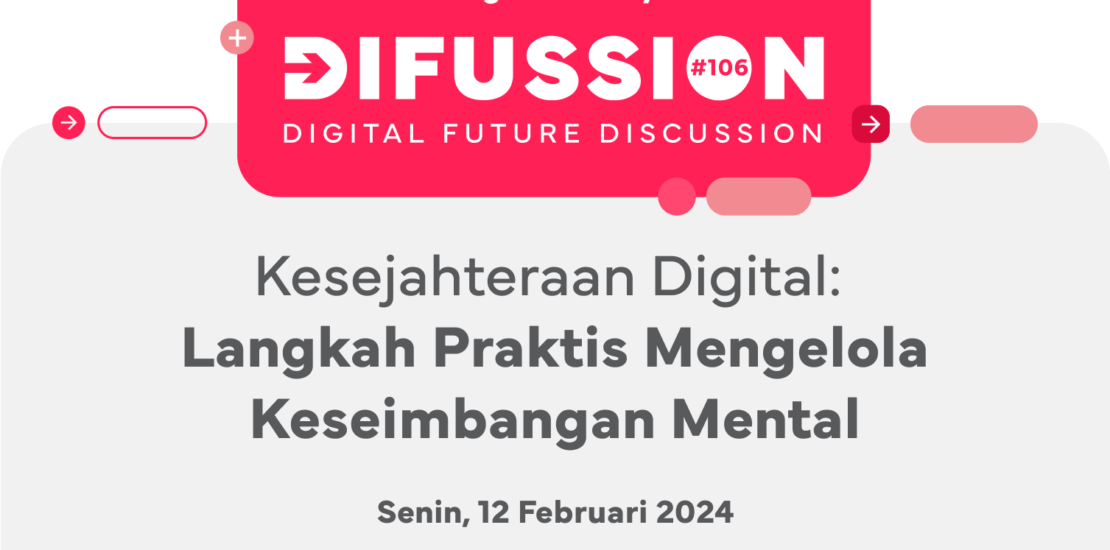

Yogyakarta (13/2/24) – The world is becoming more digital, especially due to the fast-tracked digital transformation ever since the COVID-19 pandemic. In response to this phenomenon, Center for Digital Society (CfDS) UGM held a Difussion #106 event entitled “Digital Wellbeing: Practical Steps to Manage Mental Balance”. On Monday (12/2), this event was held and broadcasted live through the Youtube and Facebook accounts of CfDS UGM at the following link http://ugm.id/livedifussion106.
This event presented Anis Fuad, S.Ked., D.E., one of CfDS’ adjunct researchers and a lecturer of FK-KMK UGM, and Rizka Herdiani, a research officer of CfDS UGM, as speakers.
The discussion began with a presentation by Rizka Herdiani who explained the concept of digital wellbeing and the effectiveness of its application today. Rizka argued how digital connectivity triggers the emergence of various phenomena, such as Zoom fatigue in work hybridization, doom scrolling, fear of missing out (FOMO), and various mental health issues. Broader issues have also emerged, such as cyberbullying and doxxing. These issues were brought to a hearing held by the United States Senate, which held the representatives of major social media platforms accountable, like Meta, X, and TikTok, for the online safety of children on their platforms.
Subsequently, Rizka introduced the concept of ‘digital wellbeing’. She argued that most people are familiar with what digital wellbeing is. Then, she emphasized that prioritizing digital wellbeing is important, given the high intensity of social media usage. However, some things need to be considered. Rizka explained, “What is used by the big platforms, the approach used is more focused on the user, or you can say: self-regulation. But, unfortunately, most of these platforms are not always efficient, because they do not always contribute to changing the behavior or habits of users. Unfortunately, it can be said that these large platforms have not actually moderated the contents well.” Besides addressing the complications of digital society being largely burdened with the responsibility to keep their own digital wellbeing, as encouraged by digital platforms, Rizka then discussed the existing approaches to maintain personal digital wellbeing.
Furthermore, Anis Fuad delivered a presentation regarding the health aspects of digital wellbeing. Anis introduced the concepts of digital health, digital wellbeing, and digital therapeutic from the perspective of medicine, and how their usage have been widely practiced. Then, Anis explained the application of health digitalization in electronic medical records, electronic health records, and personal health records, such as on national platforms like the mobile JKN application. He said that when discussing digital health and wellbeing, there are several interrelated aspects. Some of those are how digital innovation could drive change at the individual level, at the organizational level, and the various challenges that will be encountered, such as ethical issues, social impacts, and unexpected impacts.
Then, Anis mentioned the challenges related to health digitalization. Some of them are the inequality of digital infrastructure and digital maturity, health data quality issues, as well as ethics and health data safety issues. As a closure, he illustrated the posture of dealing with digitalization as facing a big wave in the ocean, and the two perspectives in dealing with it. In the first illustration, the big wave of digitalization is faced by a fisherman, who is vulnerable to being swept away by the wave. Meanwhile, in the second illustration, the big wave of digitalization is faced by a surfer, who participates in the movement of the wave and manages it. “But, if we can manage and then follow the current in order to achieve the goal, what do we use to manage it? The ABCD of digitalization, combined with EFGHI: education, ethics and regulation, financing, governance, humanity, infrastructure and security,” said Anis.
Ultimately, it is important for the digital community to have an awareness of managing the use of technology to maintain their digital wellbeing, and to voice their concerns to the government to develop better digital health services.
Author: Carmelia Gaby Talia
Editor: Allysa Putri Rendry
