- 21/08/2023
- Category: Press Release
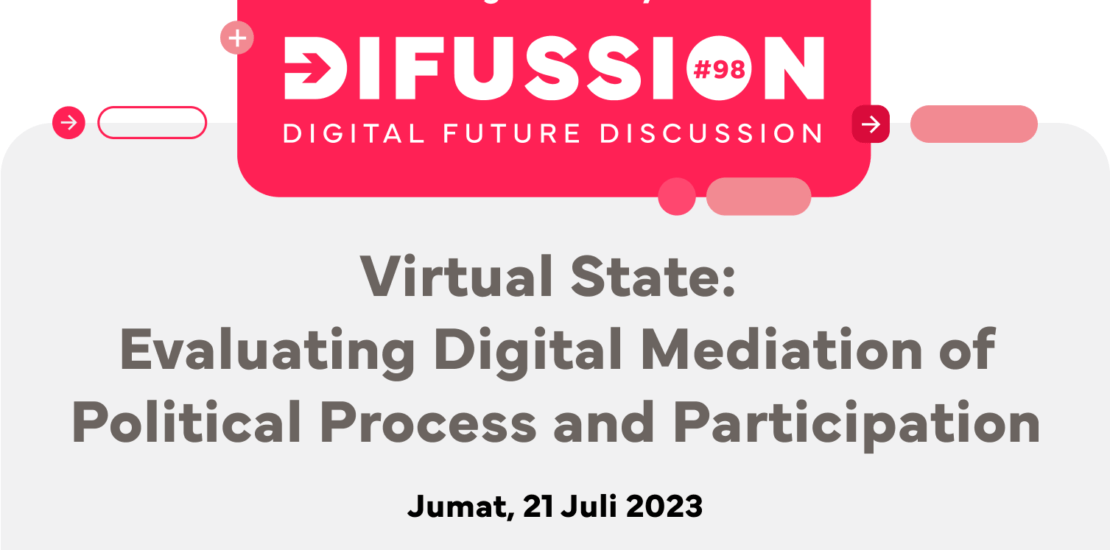
Yogyakarta, August 7, 2023 – The digital realm that has been extensively utilized in daily life is now proving to be a space for political processes and participation as well. In the 98th edition of the Digital Future Discussion (Difussion), Center for Digital Society (CfDS) UGM explored the role of the digital landscape as a mediator of political participation. Featuring Alfredo Putrawidjoyo (Research Officer at CfDS) and Bangkit Adhi Wiguna (Research Assistant at CfDS), with moderation by Allysa Putri Rendry (Partnership Assistant at CfDS), Difussion #98 delved into the ways in which young people can engage and effectively utilize the digital space. The event can be viewed again at this video.
Digital Political Participation and Digital Political Parties
Kicked off by Bangkit Adhi Wiguna’s introductory remarks, Difussion #98 commenced with an exploration of fundamental concepts related to digital politics, including digital political parties. Bangkit sparked the discussion by highlighting the ongoing debate about the political process in Indonesia, encompassing the use of the open proportional system since 2004, which is considered more democratic yet also potentially inclined towards image-based politics. “In Indonesia, the political transformation through the emergence of digital parties is a significant change,” Bangkit mentioned.
“Differing from conventional parties, digital parties involve five key elements: cloud, participationism, hyperleader, superbase, and plebiscitarianism 2.0,” continued Bangkit. First, cloud shifts operational infrastructure to the digital realm, altering the way participation and interest aggregation are conducted. However, the level of participation might be considered simplistic. Second, participationism seeks direct cultural political involvement through digital transformation, though its ultimate goals might be forgotten. Third, hyperleader merges social media celebrities with party structures, despite being contradictory to the second element. Fourth, superbase is a reactive and quantity-focused important membership structure. Fifth, plebiscitarianism 2.0 applies participationism to digital parties, displaying high responsiveness to members and constituents while limiting participation to specific policy agreements.
“Virtual State” and the Failure of Public Sector Digital Transformation”
Continuing the discussion initiated by the first speaker, Alfredo Putrawidjoyo provided his critical analysis of digital transformation in the public sector. “The suboptimality of digital technology and digital transformation is a broad term encompassing various issues,” as emphasized by Alfredo. Digital transformation in the public sector often faces failure due to several crucial factors. First, failures stem from macro paradigms where insufficient understanding of the built systems can lead to overlooked security vulnerabilities. Outsourcing IT activities and lack of internal expertise exacerbate this situation. Second, institutional aspects are another critical factor. Reliance on megadata solutions is often seen as the ultimate fix without clear political legitimacy. “The lack of citizen participation in decision-making, policy, and evaluation is also detrimental,” as expressed by Alfredo. Furthermore, institutions often fail to integrate socio-political analysis with technology rationality.
At the micro level, personal views of officials and civil servants towards technology also influence the success of transformation. Centralized investment decisions focused on buzzwords over basic infrastructure further complicate the situation. Weak leadership and dominating political motivations in data management also lead to incongruence and transformation failure. “There needs to be a two-way communication between policymakers and the public in a dedicated space. In terms of inclusivity, structural and fundamental changes are required. However, our digital space is not yet capable,” concluded Bangkit, wrapping up Alfredo’s discussion.
Author: Allysa Putri Rendry
Editor: Archandra Viryasatya Sugama
